Training and exercising programs generate valuable insight across every activity. Observations, evaluation findings, participant feedback, debrief outcomes and improvement actions all help organisations understand where capability is strong, where gaps exist and where further development is required.
The challenge is that lessons are often captured inconsistently, stored across different documents or systems, and difficult to track once the exercise has concluded. This can result in valuable findings being recorded but not acted on, limiting the long-term value of training and exercising activity. This presents an opportunity to move beyond static post-exercise reporting and establish a structured, repeatable approach to capturing, managing, and measuring lessons learned across the organisation
Why lessons learned often fail to drive improvement
While most organisations capture lessons following training and exercising activities, many struggle to consistently track actions, measure progress, and demonstrate whether improvements have actually been achieved. The result is::
- Lessons are captured in reports but not consistently tracked through to completion
- There is limited visibility of recurring themes across exercises, teams or regions
- Difficulty occurs in assigning responsibility for improvement actions
- Inconsistent reporting of progress to leadership and stakeholders is common
- There is limited ability to compare lessons and outcomes year-on-year
A structured approach to lessons learned management
A structured lessons learned approach enables organisations to capture findings from training and exercising activity, convert them into improvement actions, and track progress over time.
Using Exercise Manager, lessons identified through exercises, observations, and evaluation activity can be managed within the same environment as the broader training and exercising program. This helps ensure findings are not treated as isolated exercise outputs, but are incorporated into a structured continuous improvement process.
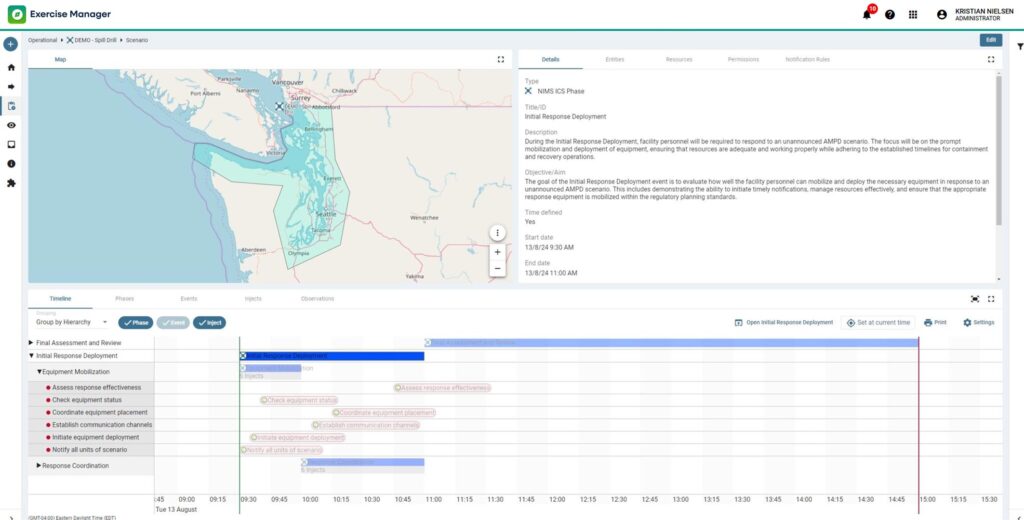
Lessons can be linked to exercises, observations, objectives, capabilities, locations, teams, or stakeholder groups, depending on how the organisation chooses to structure its preparedness model. Improvement actions can then be assigned, monitored, and reported against, creating greater accountability and visibility.
This allows the organisation to:
- Capture lessons in a consistent and structured format
- Link lessons to the exercises, observations and evaluations that generated them
- Assign actions, owners, and timeframes for follow-up activity
- Monitor progress against agreed improvements
- Identify recurring themes across multiple exercises or organisational areas
Outcome: from findings to measurable improvement
This approach supports a more mature and measurable model for continuous improvement. Daily users gain a clearer way to record findings, manage follow-up actions and understand how individual exercise outcomes contribute to broader capability development.
Program managers can monitor the status of lessons and improvement actions across multiple exercises, reducing the risk of duplicated effort or unresolved findings. They can also identify whether similar issues are recurring across different locations, teams or exercise types.
Executive and senior stakeholders gain visibility of improvement activity at an organisational level, including the status of key actions, recurring capability themes and progress against preparedness priorities.Each exercise contributes additional data, allowing the overall process to become progressively more efficient over time.
Capabilities supporting organisational learning and improvement
To support a structured and repeatable lessons learned management process, organisations need more than a place to record findings. They need the ability to connect observations, actions and outcomes, monitor progress over time and report on improvement activity at multiple levels of the organisation. Exercise Manager provides a range of capabilities that support this process, including:
- Structured capture of lessons identified and lessons learned
- Linkage between observations, evaluations, exercises and improvement actions
- Assignment of action owners, due dates and progress status
- Dashboard reporting for operational, program and executive stakeholders
- Trend analysis across exercises, teams, locations and time periods
- Custom reporting aligned to organisational governance requirements
- KPI tracking to monitor progress against improvement objectives
- Historical reporting to support year-on-year comparison
Building a long-term view of preparedness improvement
The real value of this approach increases significantly over time. In the first year, organisations can begin to establish a structured baseline of lessons, recurring findings and improvement actions. This provides a clearer picture of where capability gaps are emerging and where investment, training or further exercising may be required. In subsequent years, the organisation can compare lessons and improvement activity against previous periods. This enables year-on-year analysis of whether issues are reducing, recurring or changing in nature.
Over time, each exercise strengthens the dataset. Lessons become more than a report output; they become a measurable source of organisational intelligence that supports prioritisation, governance and continuous improvement. This delivers three measurable benefits:
- Better accountability through clear ownership, status tracking and reporting of improvement actions
- Increased awareness through visibility of recurring lessons, unresolved actions and emerging themes across the organisation
- Continuous improvement through the ability to compare lessons, actions and outcomes over time
Closing the loop between evaluation and improvements
By connecting lessons learned to the broader training and exercising lifecycle, organisations can close the loop between evaluation and improvement. This helps ensure that insight generated through exercises is not lost, but actively used to strengthen preparedness, improve decision-making and demonstrate measurable progress over time.
Lessons learned management questions and answers
What is lessons learned management? Lessons learned management is the process of capturing findings, assigning improvement actions and measuring progress over time.
Why is lessons learned management important? Lessons learned management helps organisations turn exercise findings into measurable preparedness improvements rather than leaving them in reports.
How do organisations track lessons learned? Organisations track lessons learned by linking findings to actions, assigning ownership, monitoring progress and reporting on outcomes.
How do organisations measure preparedness improvement over time? Preparedness improvement can be measured by comparing findings, actions and outcomes across multiple exercises and reporting periods.
What are the benefits of lessons learned management? The primary benefits are improved accountability, increased visibility of recurring issues and stronger continuous improvement.
How does Exercise Manager support lessons learned management? Exercise Manager supports lessons learned management by connecting findings, actions, exercises, evaluations and reporting within a single environment.