From Exercise Data to Organisational Insight
For many organisations, training and exercising programs generate significant volumes of data every year. Exercise plans, observations, participant feedback, evaluation reports, capability assessments and lessons identified all contribute valuable information about organisational preparedness.
The challenge is that this information often remains fragmented across reports, spreadsheets and individual systems, making it difficult to identify trends, measure progress or provide meaningful insights to decision-makers. A more integrated approach allows organisations to move beyond individual exercise outcomes and develop a structured, organisation-wide view of preparedness that becomes more valuable over time.
Why many organisations struggle to build a complete picture of preparedness
Organisations often collect significant amounts of information through training and exercising activities, but turning that information into meaningful organisational insight can be difficult. Common challenges include:
- Large volumes of exercise data that are difficult to consolidate and analyse
- Significant effort required to prepare reports for leadership and stakeholders
- Limited visibility of trends across multiple exercises, regions or departments
- Difficulty measuring whether preparedness is improving over time
- Inconsistent reporting methodologies across programs and teams
- Limited ability to translate exercise outcomes into strategic decision-making
Building a more connected view of preparedness
A more integrated, data-driven approach allows organisations to transform individual exercise activities into a continuous source of preparedness intelligence.
Using Exercise Manager, data generated throughout the training and exercising lifecycle is captured within a common structure. Exercise planning, delivery, observation, evaluation and reporting activities contribute to a growing dataset that can be analysed from operational, programmatic and strategic perspectives.
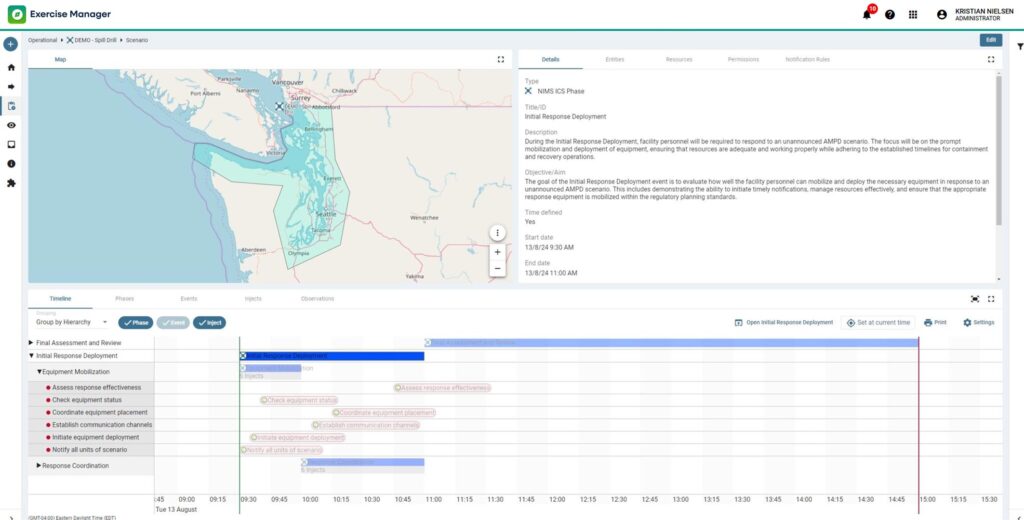
Rather than viewing each exercise as an isolated activity, organisations can build a continuously evolving picture of preparedness across departments, regions and stakeholder groups. This enables organisation to:
- Monitor preparedness activities through real-time dashboards and reporting
- Analyse outcomes across multiple exercises, programs and organisational units
- Track capability development over time using consistent data models
- Reduce reporting effort through automated reporting and dashboard generation
- Support evidence-based decision making using objective preparedness data
Better visibility for better decision-making
By bringing exercise information together within a common structure, organisations gain a more informed and measurable view of preparedness. Daily users gain immediate visibility of exercise activity, observations and evaluation outcomes. Program managers can identify recurring trends, monitor performance against objectives and track capability development across multiple exercises.
Executive stakeholders gain access to consolidated preparedness information that can be presented through tailored dashboards and reports, providing visibility of organisational performance without requiring manual consolidation of information from multiple sources.
Capabilities supporting organisational insight
Creating a meaningful picture of organisational preparedness requires more than collecting information. Data must be connected, analysed and presented in ways that support operational, program and executive decision-making. Exercise Manager supports this through:
- Real-time dashboards and reporting across training and exercising activities
- Executive dashboards designed for strategic and leadership-level oversight
- Drill-down capability from organisational summaries to individual exercise data
- Cross-workspace analytics supporting visibility across departments, regions and partner organisations
- Automated reporting to reduce administrative effort and improve consistency
- Observation analytics providing insight into recurring themes, strengths and capability gaps
- Historical trend analysis across months, years and exercise programs
- Custom reporting frameworks aligned to organisational requirements
- KPI tracking to monitor preparedness objectives and program performance
Building preparedness intelligence over time
As more exercises are planned, delivered and evaluated, organisations build a richer understanding of preparedness across the organisation. In the first year, meaningful baselines begin to emerge, providing a clearer picture of organisational performance and where additional investment, training or exercising may be required.
After the first year of data collection, organisations can begin establishing meaningful baselines. As additional years of information are accumulated, preparedness can be assessed against historical performance, seasonal trends, regional variations and organisational objectives. This creates a continuously improving cycle where each exercise not only delivers learning outcomes for participants but also strengthens the quality and value of organisational preparedness intelligence.
Long-term benefits of a data-driven approach
As organisations collect more information, they gain a richer understanding of preparedness across teams, departments and regions. This delivers three measurable benefits:
- More meaningful data through a structured and continuously expanding preparedness dataset
- Better decisions through real-time visibility, trend analysis and evidence-based reporting
- Increased awareness through tailored dashboards that provide relevant insights to operational users, program managers and executive stakeholders
By transforming exercise data into organisational intelligence, organisations can move beyond reporting what happened and begin understanding how preparedness is evolving over time. The result is a measurable, defensible and continuously improving picture of readiness that supports decision-making at every level of the organisation.
Common Questions About Organisational Preparedness
How can organisations build a more complete picture of preparedness? A more complete picture of preparedness is built by bringing together information from planning, exercising, observations, evaluations and lessons learned into a common structure. This enables organisations to identify trends, understand capability development and gain a broader view of preparedness across the organisation.
Why is exercise information often difficult to use effectively? Information generated through training and exercising is frequently spread across reports, spreadsheets and disconnected systems. Without a consistent way to consolidate and analyse that information, organisations struggle to identify trends, compare outcomes and gain meaningful organisational insight
Why is long-term exercise data valuable? Organisations track lessons learned by linking findings to actions, assigning ownership, monitoring progress and reporting on outcomes.
How do organisations measure preparedness improvement over time? The value of exercise information increases over time. As more exercises are completed, organisations can establish baselines, identify long-term trends and build a richer understanding of organisational preparedness
How does Exercise Manager support organisational preparedness? Exercise Manager connects planning, exercising, observation, evaluation and reporting within a common environment. This enables organisations to build a structured, organisation-wide view of preparedness using information generated throughout the exercising lifecycle.