Insights gathered from resilience practitioners across recent industry forums, webinars, and peer discussions point to a common challenge: the fundamentals of resilience are largely understood, but sustaining capability, engagement, and relevance is becoming harder. As organisations move beyond establishing baseline programmes, attention is increasingly focused on maintaining resilience in operational terms: how it continues to support decision-making, support leadership, and facilitate speedier recovery when organisations are under pressure.
Looking ahead in 2026, six trends are shaping the future of resilience at organizations.
1. Operational resilience is moving beyond compliance into operational reality
Operational resilience regulations have been a major driver of change, particularly in financial services and critical infrastructure. But the focus is shifting away from “meeting the rules” toward demonstrating increased operational capability.
According to the BCI Operational Resilience Report 2025, more than 70% of organisations now have an operational resilience programme in place, yet many report challenges in translating regulatory intent into day-to-day decision-making and effective responses. A measure of success is not whether frameworks exist on paper, but whether organisations can continue delivering important services within defined impact tolerances when disruption occurs.
In 2026, this distinction will continue to grow. Regulators, boards, and customers will begin to expect evidence of resilience through performance, not documentation alone. As a result, dedicated software platforms and expert consultants are playing a growing role. They help organisations operationalise regulatory concepts, align BIAs with critical services and continuity plans, identify areas for improvement, and embed resilience into decision-making during live incidents and crises, not just when preparing for audits.

Build the resilience of your organization from top to bottom
With over 25 years of experience around the globe, our consultants help organizations be better prepared and faster to respond to crises and disruptions.
2. The BIA evolves from static analysis to continuously maintained insight
The Business Impact Analysis remains foundational, but traditional, point-in-time BIAs are increasingly misaligned with how organisations operate today. Technology changes, supplier dependencies shift, and operating models evolve far faster than annual review cycles can keep pace with.
Both ISO 22301 and the BCI Good Practice Guidelines reinforce that BIA information must be maintained and kept up to date, positioning it as an ongoing management activity rather than a periodic compliance task. Yet many organisations still rely on static data collection methods that struggle to reflect real-world change.
In 2026, static BIAs will no longer be sufficient. Resilience leaders will be expected to maintain live insight into service criticality, dependencies, and impact tolerances. This is driving increased demand for specialist support, whether through enabling technology or expert consultancy, to redesign BIA approaches, integrate operational data sources, and move from annual refreshes toward rolling, event-driven analysis that supports real-time decisions.
3. Side-of-desk exercising complements desktop and simulations
Desktop exercises and annual simulations remain essential to resilience programmes, providing structured validation of roles, escalation, and coordination. However, they can struggle to replicate the sustained pressure and competing priorities leadership experienced during an actual crisis.
Side-of-desk exercising complements these formats by running in parallel with day-to-day operations. It is a high-engagement exercise model for senior leaders, requiring them to balance business-as-usual responsibilities while responding to an evolving incident, holding regular briefings, and making time-critical decisions with imperfect information. This approach reflects the reality of modern crises, which are rarely linear.
In 2026, side-of-desk exercising will become a more commonly used tool to increase leadership buy-in and develop their capabilities.
4. Visualisation becomes more common for decision-making under pressure
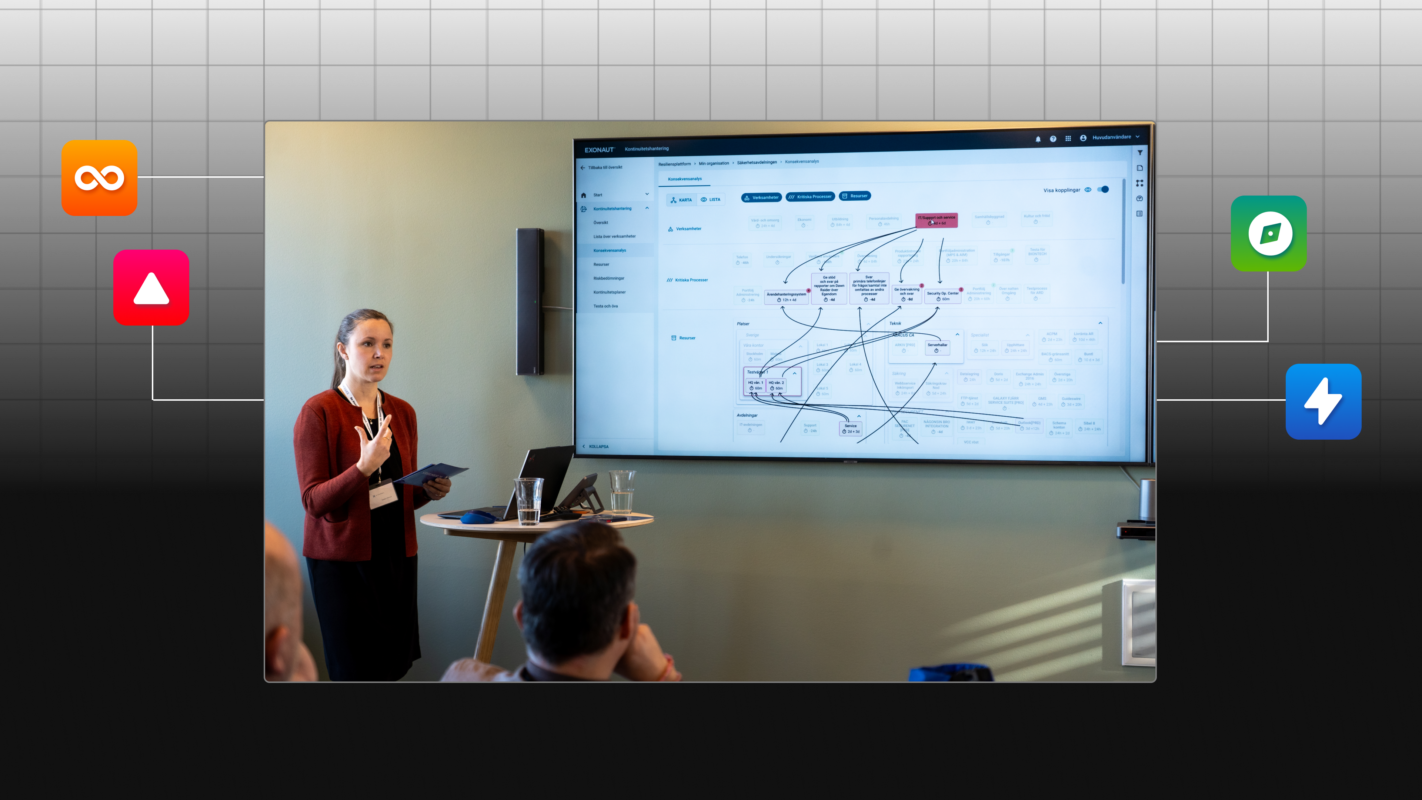
As resilience programmes expand in scope, complexity has become one of the biggest barriers to effective response. Practitioners consistently report that while data exists, it is often fragmented, difficult to interpret, and slow to translate into action during an incident.
Industry guidance on operational resilience emphasizes the need to anticipate, respond, and adapt rapidly, something that depends heavily on clarity of information. Visual tools such as dependency maps, service impact views, and recovery timelines are increasingly recognised as critical enablers of effective triage and prioritisation.
Resilience data that cannot be clearly visualised will struggle to influence decisions. Therefore in 2026, organisations will increasingly turn to dedicated resilience software providers for help to translate complex interdependencies into accessible, role-appropriate views, enabling executives, crisis leaders, and technical teams to act with confidence in a crisis when time and information are limited.
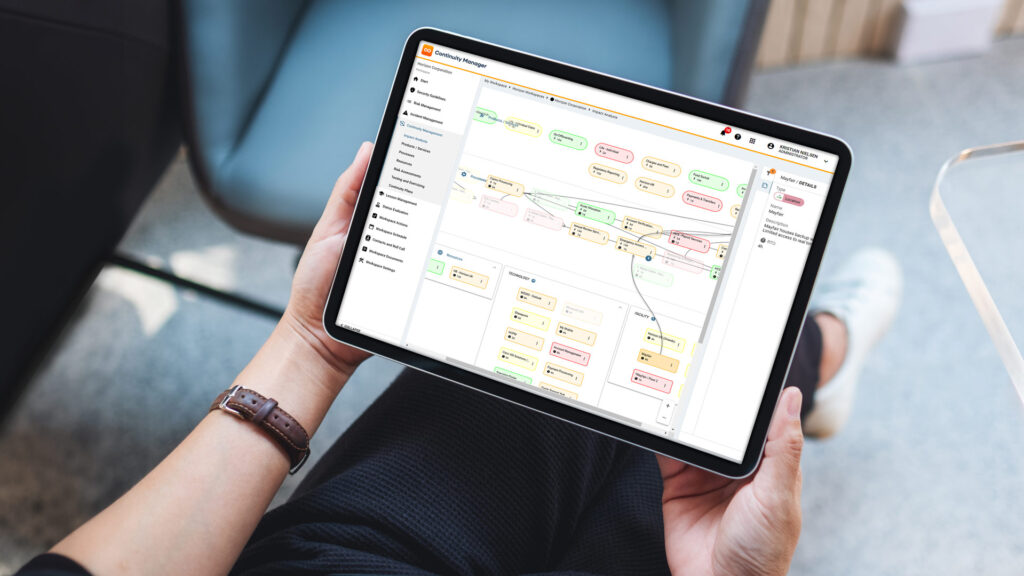
Maintain operations during disruptions
Continuity Manager takes BCM from planning to operations, ensuring you not only know what to prioritize in a disruption, but can also trigger plans to maintain critical services.
5. Whole-of-society resilience (Total Defence) extends the private-sector role
Resilience is increasingly being framed as a whole-of-society responsibility, often referred to as Total Defence. This reflects the growing prevalence of grey-zone threats – including state-sponsored cyber activity, sabotage, influence operations, and coercive disruption – that deliberately target civilian infrastructure, supply chains, and private-sector operations below the threshold of open conflict.
For private-sector organisations, this represents a shift in expectations. Resilience is no longer limited to protecting internal operations; it now includes understanding how critical services, suppliers, and decision-making align with wider societal and economic stability. Organisations are being asked to consider not only how they recover, but how their actions affect customers, partners, and critical infrastructure during periods of heightened pressure.
This shift is driving increased emphasis on sector-wide exercising and public–private collaboration, where organisations test their crisis arrangements alongside peers, regulators, and government stakeholders. Large-scale, cross-sector exercises, such as the one we conducted with the entire Hog Kong financial sector, allow organisations to validate assumptions, stress-test coordination mechanisms, and rehearse decision-making in environments that more closely reflect real-world conditions than organisation-specific simulations alone.
In 2026, whole-of-society resilience will increasingly shape private-sector resilience expectations. Organisations will be expected to demonstrate how their continuity and crisis arrangements integrate with wider response structures, support collective recovery, and contribute to societal resilience, moving beyond organisational self-sufficiency toward coordinated readiness.
6. Culture and engagement overtake frameworks as the primary constraint
Across practitioner surveys and peer discussions, one message is consistent: resilience capability is constrained less by frameworks than by sustained business engagement. The State of Continuity & Resilience 2025 shows that many organisations continue to battle fatigue, unclear ownership, and limited accountability outside of formal resilience functions.
As resilience responsibilities extend across the organisation, success increasingly depends on influence, facilitation, and behavioural change, not just technical expertise. Embedding resilience into decision-making requires alignment with existing governance, incentives, and operational rhythms.
In 2026, cultural engagement will become a key factor of resilience maturity. Many resilience teams will therefore seek targeted support from expert consultants, not for templates or plans, but to help design engagement models, clarify ownership, and embed resilience thinking into everyday business decisions, ensuring capability endures beyond individual roles or review cycles.
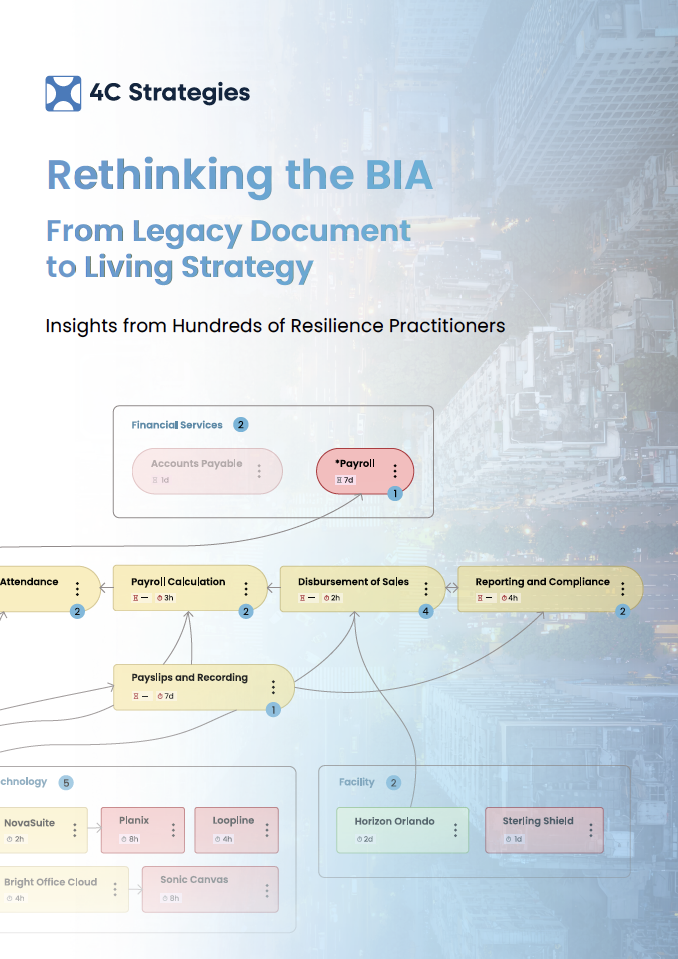
Insights from hundreds of BCM practitioners
We’ve gathered the thoughts and insights from over 100 resilience experts in our latest guide. Don’t miss what they had to say on how you can build resilience by rethinking the BIA.
To conclude…
In 2026, resilience will be defined less by what organisations document and more by how they perform under pressure. As disruptions become more complex and expectations continue to rise, the focus will shift from maintaining frameworks to enabling real-time decision-making and leadership confidence. For resilience teams, the challenge and the opportunities lie in turning established foundations into capabilities that deliver under pressure, enabling fast and effective responses regardless of the scenario being faced.
Contact our team today to start increasing the resilience of your organization.