While these teams often share similar preparedness objectives, they typically operate independently, resulting in duplicated effort, increased travel requirements and limited visibility of activity across the organisation.
Challenges of coordinating exercises across distributed teams
Distributed teams often rely on disconnected planning processes, local coordination methods and limited shared visibility across activities. As a result, organisations commonly face:
- High travel costs associated with in-person planning and coordination
- Duplication of effort across departments designing similar exercises
- Limited visibility of resource availability across regions
- Fragmented communication between planning teams and stakeholders
A more integrated approach to distributed exercise planning
Adopting a more integrated, digitally enabled approach to planning and coordinating exercises across distributed teams changges this. It improves coordination across teams while maintaining decentralised control, reducing costs, and increasing overall capacity without adding administrative burden.
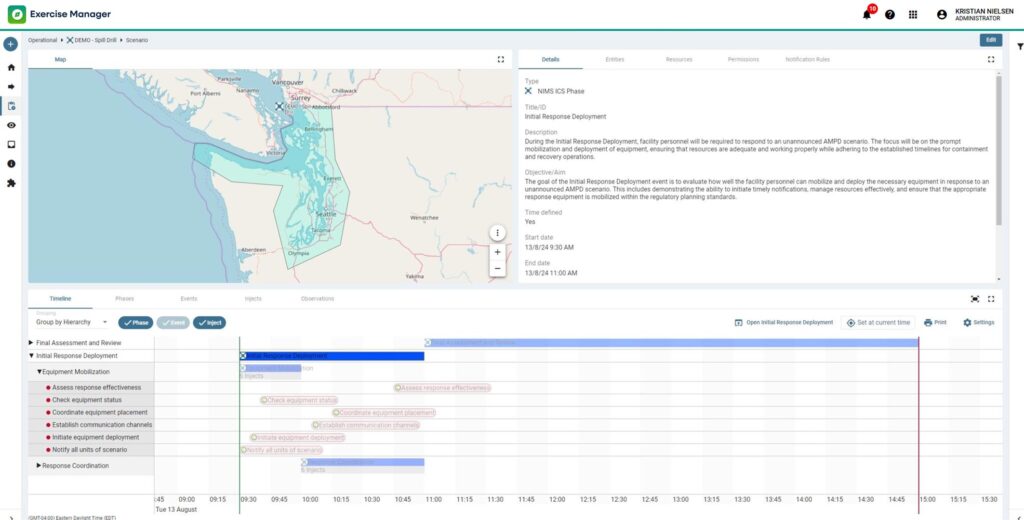
Using Exercise Manager from 4C Strategies, dispersed teams can plan, coordinate and deliver exercises within a shared environment. This is supported by built-in communications, task management and resource tracking capabilities which allow planning teams to collaborate in real-time without reliance on external tools or in-person meetings.
The task planner, using a kanban-style approach, enables distributed teams to manage exercise planning workflows, visually track progress, and allocate responsibility across multiple stakeholders.
Resource tracking capabilities provide a simple but effective way to manage resource availability. By maintaining structured records of assets (e.g. vehicles, equipment or personnel), organisations can generate real-time reports to track training demands on critical resources across regions, for more efficient planning and allocation.
Reducing coordination overhead across regions and departments
By improving coordination, visibility and collaboration across distributed teams, organisations can reduce much of the operational overhead associated with planning and delivering exercises across regions and departments. This supports a more scalable and efficient approach to training and exercising, which:
- Reduces travel and coordination costs through digital collaboration and shared planning environment
- Increases planning throughput, enabling more exercises to be delivered with the same resources
- Improves coordination across departments without centralising control
Each exercise contributes additional data, allowing the overall process to become progressively more efficient over time.
Key capabilities supporting distributed exercise coordination
- Integrated communications including messaging, task assignment and email integration
- Kanban-style task planner to manage distributed workflows
- Map-enabled exercise planning for geographically dispersed activities
- Basic asset tracking with real-time reporting on availability
- Workspace-based structure supporting collaboration across departments and regions

Improving visibility across distributed teams
By bringing planning, coordination and resource visibility into a single environment, organisations gain access to a broader and more meaningful set of data across all exercising activities. With Exercise Manager’s dashboard and reporting capabilities this data can be aggregated and presented to different stakeholder levels depending on their needs.
Operational teams can monitor task progress, communications and resource availability in real-time, reducing delays and improving coordination. Program managers gain visibility of planning activity across multiple regions, enabling better prioritisation and workload balancing. Senior stakeholders can view consolidated reporting on activity levels, resource utilisation and overall preparedness.
Measurable benefits of coordinating exercises across distributed teams
By bringing planning, coordination and resource visibility into a single environment, organisations gain access to a broader and more meaningful set of data across all exercising activities. With Exercise Manager’s dashboard and reporting capabilities this data can be aggregated and presented to different stakeholder levels depending on their needs.
Operational teams can monitor task progress, communications and resource availability in real-time, reducing delays and improving coordination. Program managers gain visibility of planning activity across multiple regions, enabling better prioritisation and workload balancing. Senior stakeholders can view consolidated reporting on activity levels, resource utilisation and overall preparedness.
Improving coordination across distributed teams
By combining distributed ownership with central visibility, large organisations can significantly reduce the cost of exercising while increasing their overall planning capacity and effectiveness.
Get in touch
If you want to know how you can get started with Exercise Manager or want to know how we support emergency services and military forces around the globe, get in touch.