I have been the game leader when several hundred people from government agencies and critical services have played the total defense game Gränsland, one of 4C Strategies’ many crisis exercises. What has stayed with me is not how much the participants know. It is how difficult it is to use that knowledge together, when the situation is unclear and time is short.
I want to share some of the things I have seen, and explain why I believe more organizations should develop their crisis management capabilities through Borderlands or more customized exercises.
A tent, a fictional country and too little information
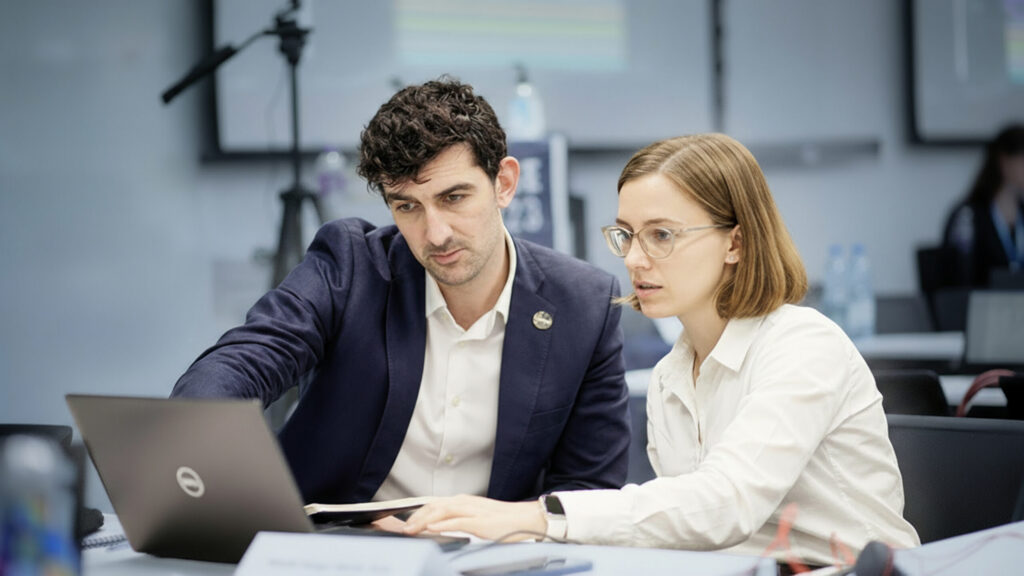
The last time we set up Borderland was during the Total Defense Fair in October 2026. The participants sat in small groups in a tent. An armed conflict escalated in the fictional country of Ardonia, while cyberattacks, disinformation, and disruptions to critical infrastructure hit society.
The participants analyzed the situation, prioritized, collaborated and formulated directions that could be acted upon.
”We build the scenario so that there is never enough information to feel safe. That’s when it gets interesting and that’s often how it is in reality, we rarely have the full picture,” says Frida Åkerberg Masori, one of 4C Strategies’ game leaders for Gränsland and also a senior consultant.
The difficult thing is making decisions despite uncertainties
What surprised me most was how quickly the groups identified the trade-offs that needed to be made. Despite great uncertainties, they managed to work with assumptions about the development of the situation and possible consequences to create a sufficiently good basis for decisions. It is not about eliminating uncertainty, but about being able to make well-founded decisions even though you do not have the whole picture.
Lack of resources shows what your real priorities are
As long as the resources are sufficient for everything, we often agree. When they don’t, it becomes clear what the organization actually prioritizes, and whether the group can say no to something that is also important. I have seen experienced managers hesitate for a long time before making that particular decision. It is a conversation that is rarely had in everyday life, and therefore it takes too long in a crisis.
Collaboration is tested where responsibilities overlap
Many questions in the game fall between the responsibilities of several actors, just like in real life. This creates either duplication of work or gaps. The groups that asked early on who does what, and said out loud what they themselves took, came the furthest.
”The strongest crisis management teams are rarely the ones with the most experts around the table. It’s the ones who are good at listening to each other and taking in different perspectives,” says Frida Åkerberg Masori.
Why a fictional country gives more honest answers
I am often asked if it wouldn’t be better to practice in a scenario that is similar to your own operations. And that is certainly a reasonable question. Usually we practice with organizations within the framework of their own operations and in scenarios that are close to them. In the case of Gränsland, however, there were reasons to go outside the usual set-up.
When the entire “world” is fictional, no one needs to defend their routines or their mandate. There are no right or wrong, and no one checks whether the checklist was followed. Then you dare to reason openly, try an idea that may not work and say that you are unsure. That is also when it becomes visible how the group actually makes decisions. The fictional world also enables a different type of escalation and removes risks around the sharing of protected information.
Gränsland is safe, engaging and unprestigious, but it is truly challenging. The focus is on learning: how it feels to make decisions when the conditions are unclear, what happens in the group when resources are insufficient and how collaboration works when areas of responsibility overlap.
Play Gränsland in your own organization
Borderlands can be played in your management team, your crisis organization or together with the actors you collaborate with in a critical situation. The exercise is led by 4C Strategies’ game leader.
You will practice making judgments under uncertainty, prioritizing under resource constraints, collaborating across organizational boundaries, and making strategic decisions when time is tight. Above all, you will see how your organization functions when the situation is unclear, and not just how it functions on paper.
Please contact me if you would like to know more about how you can play Gränsland in your organization. Or read more here .